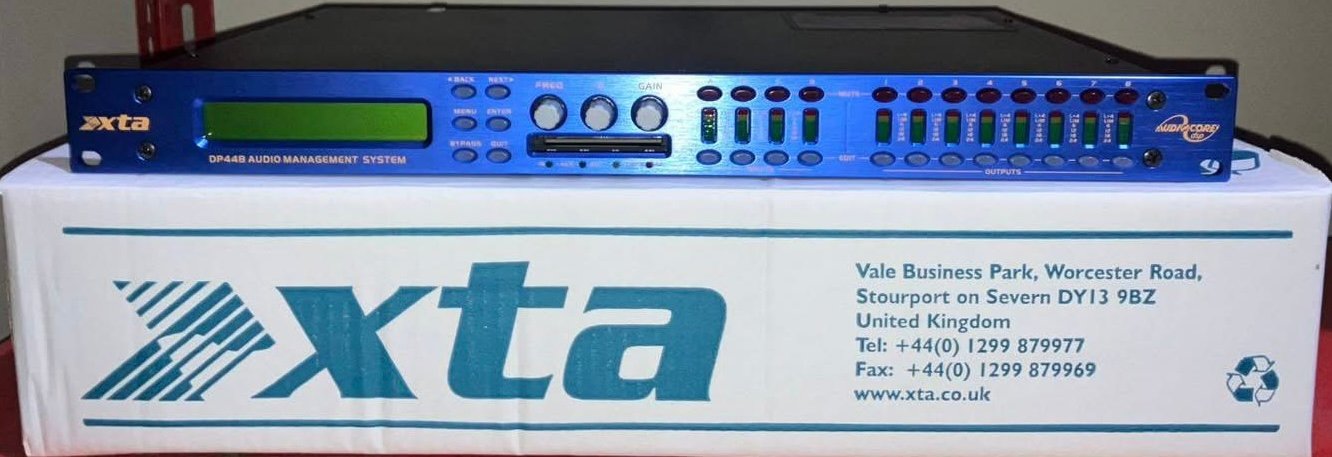
XTA DP448 audio management processor
The XTA DP448 is a four-input, eight-output audio management processor in XTA’s 4 Series. It is available in Excellent condition for €500 per unit, with 2 units available. The numbered input and output sections and exact DP448 model marking are visible in the supplied photograph.
Four inputs and eight outputs
The DP448’s channel arrangement provides a useful framework for assigning several independently processed system feeds. When planning a sound system, begin by identifying the incoming sources and the destinations that need separate output paths. That establishes the routing requirement before filter or equaliser settings are selected.
XTA’s 4 Series documentation describes free-assignment routing together with input and output processing. The available functions include input graphic and parametric equalisation, output parametric equalisation, delay, high-pass and low-pass crossover filters, and limiting. These stages address separate tasks within the signal path rather than serving as alternative names for the same adjustment.
Shaping and aligning a system
Equalisation changes the balance of frequencies in a feed. Crossover filters establish the frequency bands sent to particular outputs, while delay addresses timing relationships. Limiting sets a boundary for signal level according to the chosen system requirements. Choosing useful values therefore starts with the actual loudspeaker and amplifier arrangement, the intended coverage and the operating limits of the connected equipment.
The eight-output layout allows the engineer to think about each destination independently. Clear channel names and a documented routing plan can make an established rack easier to maintain, particularly where an installation serves several zones or where a mobile rack is used for different sound-system layouts.
Analogue and digital signal paths
The official 4 Series manual describes AES digital input and output operation as standard, with input sample-rate conversion and independent input/output selection. The source format and the destination format should therefore be considered separately when planning connections. Confirm the exact routing and rear-panel labelling from the manufacturer’s guide before changing an existing rack.
Presets and local control
XTA separates input, crossover and graphic-EQ memory sections. This gives a useful distinction between settings associated with an incoming source, settings associated with the output system and the graphic equaliser. When recalling a stored setup, the engineer should understand which parts of the operating arrangement the recall is intended to change.
The front panel combines a display, navigation controls, rotary adjustments and individual channel indication. It provides local access to the processor at the rack. Keeping the stored configuration and the physical channel labelling aligned makes that local view more useful during setup and operation.
Manufacturer reference and related equipment
Visit the official XTA DP4/DP5/DC1048 information page for the manufacturer’s current documentation collection. Browse processors at Bsound Pro Audio for related equipment.
Separating source processing from system processing
The XTA DP448 sits at a useful boundary between incoming programme material and the outputs feeding the rest of a sound system. Its four inputs and eight outputs encourage the engineer to describe both sides of that boundary explicitly. The incoming feeds need clear identities, and every output needs a defined destination. Only then is it possible to decide which processing belongs to a source and which belongs to the loudspeaker system.
A source may need a level adjustment or a particular equalisation choice without changing the output arrangement. A loudspeaker system may need its crossover, timing and protection configuration to stay consistent while different sources are selected. These are distinct operating decisions. Treating them separately helps explain why an input setting, a graphic-EQ setting and a crossover memory should not automatically be recalled as though they were one inseparable object.
The DP448’s split memory structure is therefore more than a filing convention. It gives an engineer a way to think about what should change when a stored setup is recalled. Before using a memory in an established system, identify whether it concerns the source, the output system, the graphic equaliser or a deliberate combination. That simple distinction can prevent a source change from inadvertently becoming a wider system change.
Planning eight independent destinations
The output count is useful when a sound system has several feeds that require different treatment. The exact allocation depends on the application. A destination may need an independent level because of its listening area, different timing because of its position or a different frequency band because of its role in the loudspeaker arrangement. The output names should make those intentions visible.
There is no universal eight-output layout that suits every rack. Start with the system drawing and allocate the processor to the required tasks. If several outputs carry similar audio, record why they remain separate. If a destination uses a combination of signals, record the intended source relationship. This makes later fault-finding more focused because an engineer can compare what the processor is doing with what the design says it should do.
Individual channel controls are most useful when they correspond to a clear plan. A mute button, an output level and a meter indication can then be understood in relation to a particular destination. The same controls are much less informative when the rack is labelled only with channel numbers and no record of the connected system.
Graphic and parametric equalisation
A graphic equaliser presents frequency adjustment through a defined set of bands. A parametric equaliser allows a filter to be described through parameters such as centre frequency, bandwidth and gain. Both affect frequency response, but they offer different ways to approach an adjustment. Their usefulness depends on the task and on how the engineer intends to operate the processor.
In a management processor such as the DP448, it is helpful to distinguish broad operating adjustments from the model-specific output settings that belong to the loudspeaker design. A change made to accommodate a source or venue should not obscure the reasons for the underlying system settings. Keeping records of the two decisions makes the final configuration easier to review.
Equalisation also needs to be considered alongside available level and the rest of the signal path. Increasing a band changes more than the appearance of a curve on a screen. It affects the signal sent onward. That is one reason to monitor the complete gain structure and to make changes in a controlled way, rather than treating equalisation as an isolated cosmetic setting.
Digital routing without assumptions
AES input and output operation creates additional connection choices, but it also introduces format and clocking questions. Identify the format produced by the source, the format required by the destination and the intended digital reference before deciding how to configure the processor. A digital connector being physically present is not the same as an established audio link.
Where analogue and digital equipment meet in the same rack, document both the audio route and the selected input/output format. That prevents a replacement cable or a processor change from becoming a guessing exercise. The DP448’s appropriate manufacturer instructions should be used for its exact rear-panel selection and digital operating arrangements.
Local operation and repeatable rack layouts
The photographed processor gives the operator local access to its display, navigation keys and parameter controls. This is useful when working at the rack, but clear operation still begins with a comprehensible configuration. Give channels meaningful names, record the intended memory behaviour and retain a system diagram that can be compared with the physical connections.
For an additional DP448 being incorporated into an existing inventory, compare the intended role with the settings of the established units. The useful aim is consistent operating behaviour where the application calls for it, not an assumption that every unit should carry identical settings. Different loudspeaker destinations or source arrangements may need deliberately different configurations even when the processor model is the same.
The XTA DP448 is thus best evaluated as part of an audio-management workflow: routing incoming feeds, applying the processing appropriate to each task and distributing a defined set of outputs. Its exact four-input/eight-output identity provides the starting framework; the system design determines how that framework is used.
Input and output ganging
The 4 Series manual separately documents input ganging and output ganging. This gives the engineer another reason to distinguish the source side of the DP448 from the destination side. Related inputs may need to follow the same operating adjustment, while related outputs may belong to a different control relationship.
A gang should reflect an understood system requirement. Before using it, decide which channels need to change together and which must remain independent. Record that decision with the routing plan. Similar channel numbers or adjacent output sockets are not, by themselves, a reason to link controls.
For an installation operated by several people, this can make a practical difference. An operator should be able to understand whether an adjustment concerns one feed or a related set of feeds before making it. A clear name and an operating note make that relationship visible. The DP448’s grouping and memory facilities are most useful when they support a documented system rather than conceal its structure.
These control relationships should also be reviewed when adapting a configuration for a different application. Keep the intended source and output roles in view so that a convenient old gang does not become an unexplained connection between otherwise independent system feeds.

There are no reviews yet. Be the first one to write one.