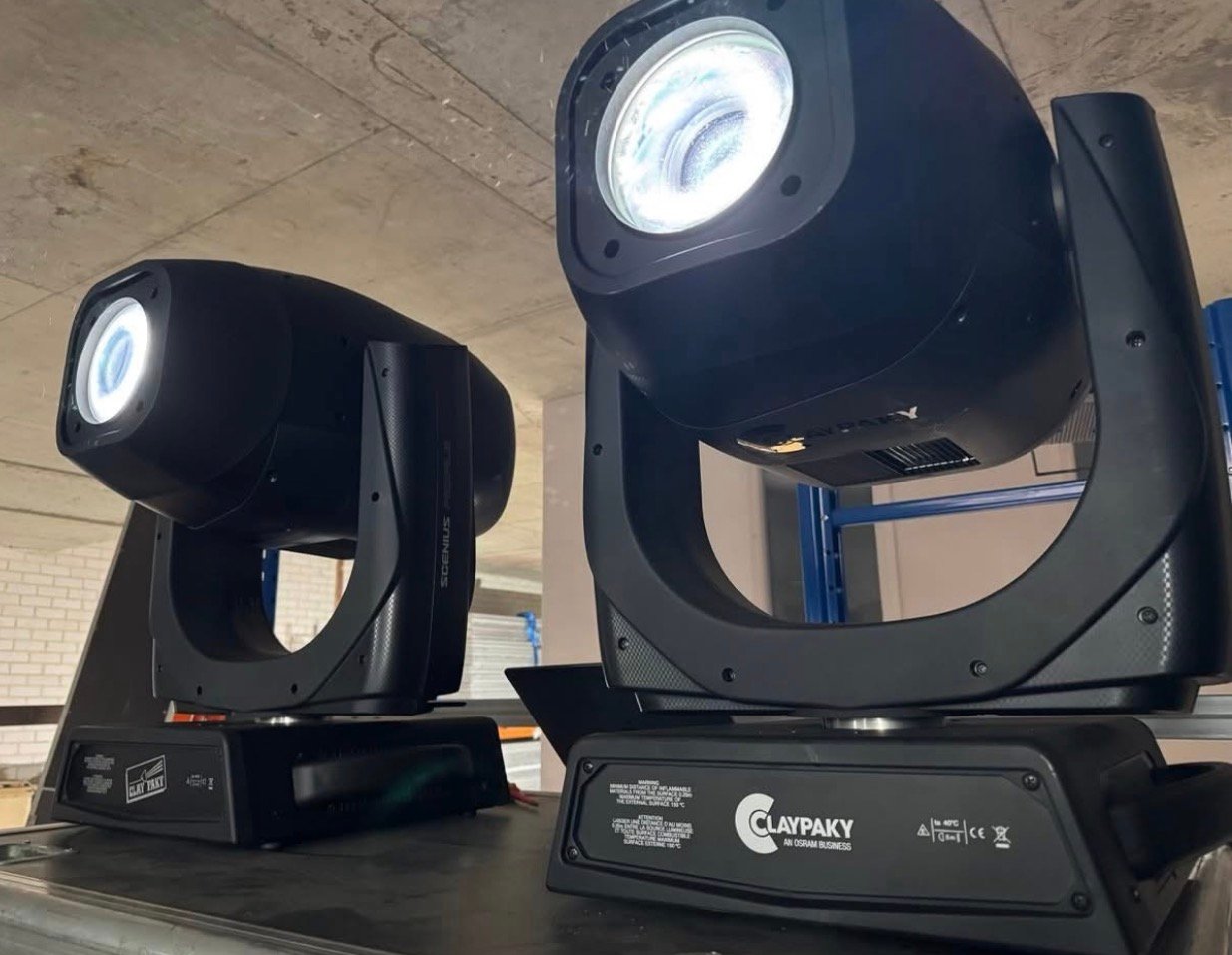
Clay Paky Scenius Profile is offered in excellent condition at €1,200 per unit. Available stock: 22 units. The quantity is the available inventory count; the price applies to one unit.
Clay Paky Scenius Profile: a framing moving head
The Clay Paky Scenius Profile is a discharge-source moving head with a dedicated framing system. The manufacturer describes a 1,400 W Osram lamp and an optical system intended to create an even projected field. Its Profile designation separates it from the Scenius Spot and Scenius Unico, so those neighboring models should not be used as substitutes when selecting a technical specification or console personality.
Four independently controlled overlapping blades shape the light. That framing capability is useful to evaluate when a design must define edges or alter the proportions of an illuminated area. A frame and a projected gobo are different tools; the choice depends on the desired shape and texture, as well as the fixture position.
Color and optical adjustment
Claypaky’s manufacturer material specifies an 8–50° zoom, CMY color mixing and linear CTO. A rotating prism, variable frost and a dimmer provide additional control of the projected result. Together, these are the model’s documented ways of changing beam size, color and texture; they are not evidence of the lamp age or the current calibration of a particular used unit.
For an existing rig, check the exact Scenius Profile control documentation before patching. Framing positions, zoom and focus should be planned for the actual throw and surface rather than inferred from a product name. The linked manufacturer article is also helpful for distinguishing Profile’s framing system from the effects arrangement of other Scenius fixtures. No case, lamp replacement history or additional mounting equipment is specified by the inventory.
Framing, focus and a deliberately shaped field
The Scenius Profile’s blade system is relevant when light must be confined to a chosen portion of a stage picture. Blade position and module orientation define the boundary, while focus determines how that boundary is presented. A crisp cut and a softened field are different creative decisions. Evaluate them against the intended throw and surface instead of assuming that one fixture position will produce every shape equally well.
CMY and CTO address the color treatment independently of that geometry. A programmer can therefore consider the shape first, then the color and intensity, or make those changes together within a cue. This separation is useful when a fixture must move between scenic illumination and a more visible effects role. The resulting look depends on the design and placement, not on lamp wattage alone.
When assessing an addition to an existing Scenius stock, use the Profile model’s own control reference. Similar family names do not establish identical optical modules. Confirming the correct profile keeps the programmed framing and effect controls aligned with the physical fixture.
Documentation and related equipment
Clay Paky official product documentation
There are no reviews yet. Be the first one to write one.