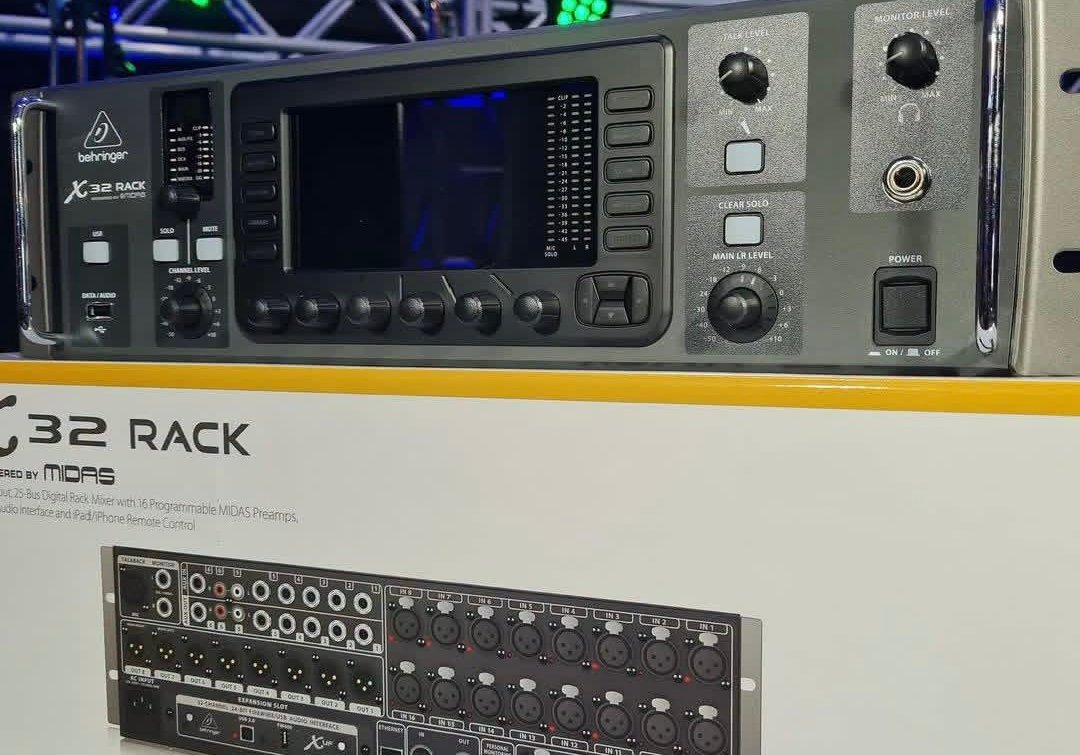
Behringer X32 Rack
Behringer X32 Rack digital mixer
Behringer X32 Rack puts the X32 mixing engine in a compact rack format. The manufacturer specifies forty input channels, twenty-five buses, sixteen Midas-designed microphone preamplifiers and a five-inch colour display. It provides digital mixing without the full-size X32 console’s bank of physical channel faders.
Inputs and audio networking
The sixteen local microphone inputs provide programmable gain and switchable phantom power. Two AES50 ports offer digital I/O expansion, while ULTRANET supports the family’s personal-monitoring connection format. These ports are useful when deciding where the mixer and stage-end connections should sit, but an external stagebox or personal mixer is a separate device.
Mixes and processing
Sixteen mix buses and six matrix paths provide routing for monitor feeds and output zones. Eight stereo effects engines bring processing into the mixer rather than requiring every effect to occupy an external rack unit. The source, bus and output routing still needs to be arranged for the event; a channel or bus count is capacity, not a fixed show layout.
Control and recall
The front display supports local operation, and editing software can connect over Ethernet. Scene recall stores mixer settings, including preamp settings, so it can provide a repeatable starting point for different events. Recalling a show should still be followed by a check of patching and output assignments for the actual system in use.
Recording facilities
Behringer documents up to thirty-two channels in and thirty-two channels out over USB for computer recording and playback. The front USB port can record a stereo board mix. The installed expansion-card type and computer setup are relevant to the exact recording workflow; a particular external computer, interface driver or software licence is not part of the named mixer.
Choosing the rack version
The X32 Rack is suited to situations where rack space and remote control are more useful than a large local fader surface. It remains a separate product from X32 Compact, Producer and the full console. This listing is for the named rack mixer in excellent condition, with one stock unit available at the stated unit price.
Read input capacity and socket count separately
The forty-input description concerns the mixing engine, while sixteen microphone preamps describe the local analogue microphone connections. Planning a show means answering both questions: how many signals need processing, and where those signals physically enter the system. A stereo playback source, for example, occupies two audio paths even if it comes from one player. Writing the source list before choosing routing prevents a common mistake: treating every channel displayed in the mixer as an additional physical microphone socket. Digital expansion adds another connection route, subject to the actual devices and patching used. It does not change the number of local XLR preamps on the rack chassis.
An illustrative compact-band layout
For a small-band example, an engineer could begin with a named input list for voices, instrument microphones and stereo playback, then reserve clearly labelled channels for guest or announcement sources. The useful part of this approach is the plan, rather than a prescribed channel numbering scheme. Decide which sources need phantom power, identify the corresponding physical sockets, and note where each feed must go. A rack mixer may be tucked beside the stage, so clear labelling reduces the need to trace a cable while the event is running. This is an example of using the mixer’s routing facilities; the instruments, microphones and playback device are not package contents.
Separate preamp gain from mix balance
The input preamp establishes the level entering the mixer; the channel fader establishes that source’s contribution to a mix. Those controls solve different problems. If a source arrives too strongly at the input, lowering the main fader does not undo overload that has already occurred earlier. Conversely, raising a quiet channel in the main mix does not establish that its input gain was set sensibly. During preparation, listen to representative loud passages and observe input metering before building the overall balance. Save the resulting settings only after checking the actual performers and sources. A recalled scene from another event is a starting configuration, not evidence that today’s levels are correct.
Plan monitor feeds independently
The X32 Rack’s mix buses allow different balances to be created for different destinations. A performer’s monitor may need more voice and less audience playback than the main mix. The send position determines how that feed relates to channel processing and the main-channel fader. A pre-fader monitor arrangement can preserve its level while the engineer changes the audience mix; a post-fader effect send can track a source’s main level. The right choice depends on the intended result. Name the destination first, then select the send behaviour. This makes a monitor request a change to a known mix, rather than an unexplained movement in the overall routing.
Use matrices for the right task
A matrix is useful when an output needs a controlled version of an existing mix, rather than another independent balance assembled directly from every microphone. For an illustrative event, the main audience mix and a separate zone might need different output levels or processing. Think through which mix should feed that zone and where the final level is controlled. The six matrix paths provide tools for this planning, while the actual socket patch determines where the audio leaves. Keep the distinction between a signal path and a rear-panel connector visible in the show notes. That distinction is particularly useful when a rack changes between local outputs and a digital stage connection.
Distinguish audio networking from control networking
AES50 carries the mixer family’s digital audio connections, while Ethernet editing provides remote control of the mixer. Their use of familiar cable and connector formats does not make their functions interchangeable. Identify each rear-panel port and the intended endpoint before connecting the system. A remote-control tablet also depends on the separately arranged control network and software, so it should be considered part of the operating plan rather than a built-in wireless feature of the rack. Keep a practical means of local access to the display and controls. The small chassis remains useful only if the operator can reach the functions needed for that particular show.
Choose the recording feed deliberately
A stereo board recording and a multitrack computer recording answer different needs. A board recording preserves the selected mix; separate tracks provide more opportunities to rebalance sources later. The manual’s routing facilities let the engineer choose signal sources and tap points, which determines how much of the live processing or fader movement reaches a recorder. Before the event, record and replay a short representative passage. Check that the intended channels arrive in the expected order, rather than relying only on visible meter activity. USB capacity describes the interface’s available paths; the installed card, recording software and computer arrangement still determine the actual capture workflow.
Recall with an output plan in front of you
Scene recall is valuable when a band or venue returns, but the current physical patch still needs to match the recalled design. Begin with the output list: which connector feeds the main PA, which feeds a monitor, and which carries a recording or zone feed. Then verify the input sources and preamp requirements. This order makes an unexpected route easier to spot before levels are raised. Keep a clear version name when saving show changes so that an earlier rehearsal state is not confused with the performance state. These are operating practices for a recallable mixer; they do not imply that show files or a preconfigured installation accompany the offered unit.
Assess whether the rack format suits the operator
The rack version trades the large bank of channel faders for a smaller local interface and remote-editing workflow. That is useful when the mixer can live near the inputs or when the venue has little room for a full control surface. It also means the buyer should think about how often rapid hands-on changes are needed and how the control device will be supported. A fixed installation with repeatable scenes and a touring show with frequent improvised changes may place different demands on the operator. Choose the format around that workflow, along with the real input and output requirements, rather than treating every X32 model as physically identical.
Use talkback as its own communication path
The dedicated talkback input gives the operator a way to communicate with performers. Decide which monitor destinations need that communication and keep that route distinct from the audience programme. An illustrative rehearsal might need a message in the musicians’ monitors while the main PA remains on its normal programme feed. Test the intended destination and level before relying on it during a changeover. Naming that route also helps another engineer understand why an additional microphone input is present. A communication facility is useful when its operation is deliberate; the presence of a talkback connection does not supply the talkback microphone or establish a saved destination assignment.
Condition, availability and price
Behringer X32 Rack is offered in Excellent condition. Available stock: 1. Unit price: €300. The quantity is the available stock count and the price applies to one listed unit.
Manufacturer documentation
Read the official Behringer X32 RACK product information.

There are no reviews yet. Be the first one to write one.