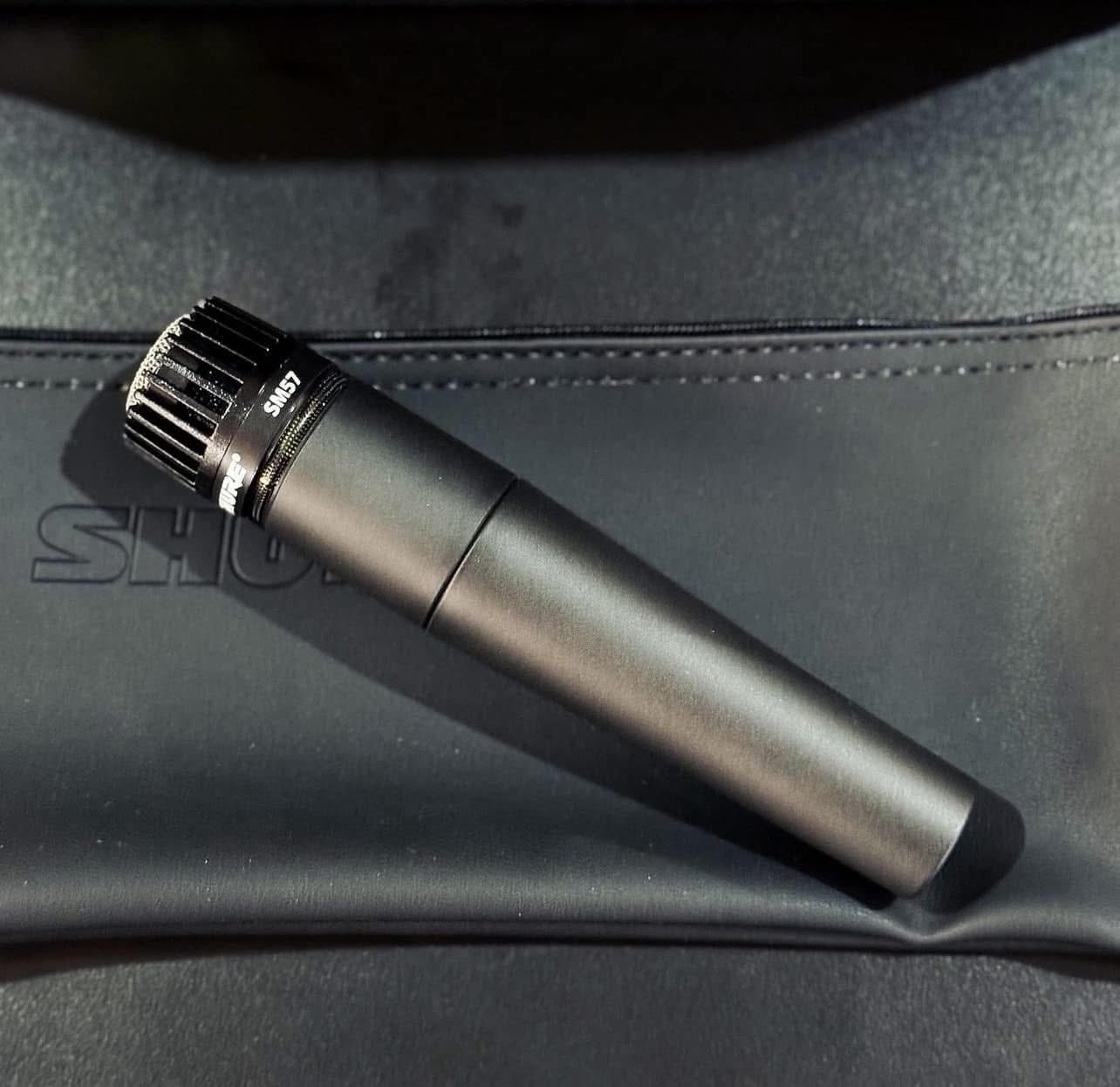
Shure SM57 Microphone
Shure SM57 Microphone
Shure SM57 Microphone is a dynamic cardioid microphone used for instrument pickup in live sound and recording. Its contoured response includes a presence rise, and the manufacturer specifies a 40 Hz to 15 kHz frequency response. The compact grille format lets the microphone be positioned near drums, instrument speakers and other sources.
Instrument applications
Shure identifies drums, percussion, instrument amplifiers and wind instruments among the SM57’s applications. On a guitar speaker, placement toward the centre of the cone gives a different balance from placement near its edge. With a drum, the capsule’s angle and height influence the relationship between attack, body and spill from the rest of the kit.
Cardioid pickup and spill
The microphone’s front is the main pickup direction, with greater rejection toward the rear. Aiming it toward the intended source and away from competing sources makes practical use of that pattern. Position remains part of the sound: a cardioid microphone will still pick up other instruments and the room according to their relative level and angle.
Distance and tone
Close placement can increase bass response through proximity effect and improve separation from more distant sources. Moving away changes that balance and allows more room contribution. The guide treats example placements as starting points; the player, instrument, room and desired mix determine which position is useful.
Handling and physical design
A pneumatic shock-mount system reduces mechanical-noise transmission. Shure’s guide notes that the top grille can rotate as part of its design, so free rotation alone does not establish a broken microphone. Grille vents should remain clear: tape or a hand covering those openings can change the intended directional response.
What the listing includes by name
This is the SM57 Microphone model, with fifty units available in excellent condition and pricing per microphone. It does not imply a drum kit, paired set or microphone/accessory bundle. Cables, clips, mounts, windscreens, stands, cases and individual test documentation are not added to the offered stock description.
Start from the sound at the source
An SM57 captures the instrument and position presented to it. Before a recording, listen to the drum or amplifier in the room and establish the intended sound with the musician. A microphone cannot restore the tone of a poorly prepared source simply because the model is familiar. The benefit of a repeatable microphone is that it provides a consistent tool while those source and placement decisions are made. Use a short recorded comparison rather than relying only on the sound heard beside the player. That makes it easier to distinguish a source problem from a microphone-position problem and avoids using processing to solve the wrong issue.
Choose a practical snare position
On a snare, start with enough clearance for normal stick movement and a clear view of the microphone’s position. Shure’s model-specific snare guidance treats distance, top/bottom position and the player’s technique as linked decisions. A very close position may emphasise one part of the head rather than the complete drum. Moving back can produce a different balance of attack and resonance, while also changing spill from the rest of the kit. Audition small changes in context. The SM57 is a durable instrument microphone, but its grille should not be deliberately placed where repeated stick impacts are expected. Practical clearance is part of microphone technique.
Understand a top-and-bottom snare combination
A second microphone below a snare can contribute a different part of the sound from a top microphone. When both are used, compare their combined result and the effect of polarity at the receiving equipment. The physical relationship between the signals matters as much as the appeal of either soloed sound. The objective is a useful composite drum tone rather than simply two active channels. Begin with one clear reference, then add the second signal deliberately. This is an illustrative recording technique for the SM57’s documented application; the listing offers an individual microphone, not a top/bottom pair or a drum-microphone package.
Move across a guitar speaker deliberately
For an electric-guitar cabinet, a small movement across the speaker can make a large tonal difference. Shure’s guitar guidance describes a brighter result nearer the centre and a warmer balance farther toward the edge, with distance affecting room contribution. Keep the amplifier and performance consistent while making the comparison. The SM57’s compact front assembly is useful for close positioning, but the visually nearest point is not necessarily the best-sounding one. Mark a successful position in the session notes if repeatability matters. The relevant result is how the guitar sits with the other instruments, rather than whether the soloed track sounds impressive at an unmatched playback level.
Compare angle and distance as separate variables
Changing angle, lateral position and distance together makes it difficult to know why the sound changed. With an SM57 on an amplifier or acoustic instrument, hold two of those factors steady while adjusting the third. Listen for the balance of attack, body and surrounding sound. A close position can improve separation while altering bass response through proximity effect. A more distant position may admit a broader acoustic picture. Neither choice is universally correct. The microphone’s role is to provide a controllable capture of the source; the musical arrangement, room and desired production determine which physical position is useful.
Use the cardioid rear direction for separation
The SM57’s cardioid pattern is useful when its orientation takes account of nearby competing sources. On a crowded stage, consider where the rear points as well as where the front is aimed. Rotating the microphone can change unwanted pickup even when its distance from the intended instrument remains similar. Check that change with the band playing, because an isolated soundcheck hit does not reveal all the spill in a performance. Directionality reduces some contributions; it does not create a silent boundary around the microphone. A sensible stage layout and microphone position remain relevant to the amount of separation obtained from this model.
Compare the grille with a vocal microphone
Shure explains that the SM57 and SM58 are based on the same cartridge design with different grille arrangements. The SM57’s smaller resonator/grille structure permits a closer acoustic approach and gives it a different response above the midrange. The SM58’s ball grille includes pop filtering for handheld vocals. This helps explain why an SM57 can be physically convenient near an instrument while an SM58 is a familiar vocal choice. It does not mean that removing or replacing a grille turns one model into the other. The offered product is the SM57 named in the inventory, with its own documentation and model-specific front assembly.
Keep vocal use a considered application
The SM57 can be used on voice, as its guide and Shure’s selection references document. A voice application still needs attention to breath noise, working distance and the chosen support arrangement. Its instrument-style grille is a different starting point from the SM58’s spherical pop-filter format. Audition the voice at realistic level and angle, then decide whether supporting wind protection is needed for the particular use. No extra windscreen is assumed in this stock listing. The useful point is the model’s flexibility: a microphone bought for instruments may also be worth testing on a voice, without claiming that every vocalist or room will produce the same result.
Check the whole input path with loud sources
A loud instrument can produce a strong signal farther along the recording chain. Set the preamp using a representative performance and inspect the receiving input for overload. The microphone, preamp, converter and later processing are separate stages, so lowering an output level does not necessarily remove distortion created earlier. A clean recorded test is a practical confirmation. Keep the cable and support clear of the player’s movement so that a successful position remains stable through the take. These are operating considerations for the named microphone; no cable, stand, interface, test certificate or service history is added to the commercial description.
Use a tom placement as a starting experiment
The SM57 guide includes tom-tom use alongside snare and amplifier applications. A position just above the head can provide a controllable relationship between attack and resonance, while a microphone shared between two toms produces a different balance and less independent adjustment. Choose the approach around the input list and musical requirement. Keep the microphone clear of the player and listen with the whole kit being played. A good isolated hit is only part of the result: cymbal spill and the interaction with overhead microphones also influence whether that close signal is useful in the eventual mix.
Make a repeatable cabinet comparison
When an amplifier position works, document its relation to the actual speaker, rather than only the outer cabinet grille. Two visually similar points can face different parts of a multi-speaker cabinet. Note the approximate distance, lateral position and angle, then compare the sound after any move. Rechecking the amplifier’s level and tone settings also avoids attributing a source change to the microphone. This practical record is useful when the SM57 is moved between instruments during a session. It supports a repeatable starting point while leaving room for the different performance, arrangement and room conditions of the next recording.
Condition, availability and price
Shure SM57 Microphone is offered in Excellent condition. Available stock: 50. Unit price: €50. The quantity is the available stock count and the price applies to one listed unit.
Manufacturer documentation
Read the official Shure SM57 user guide.
Related equipment
Browse Microphones at Bsound Pro Audio.

There are no reviews yet. Be the first one to write one.