
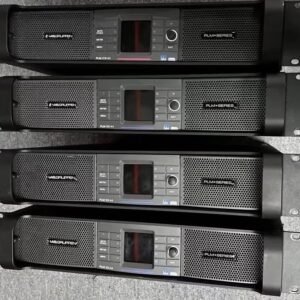
Void Bias Q5 is offered in excellent condition at €2,500 per unit. Available stock: 4 units. The quantity is the available inventory count; the price applies to one unit.
Void Bias Q5: four-channel amplification and DSP
The Void Bias Q5 combines four amplifier channels with integrated DSP in a 1U format. The official manufacturer page specifies 1,600 W per channel at 8 Ω and 3,000 W per channel at 4 Ω. Those ratings need to be read with their stated load conditions, rather than reduced to a single figure without context.
The documented inputs include analogue and AES3, and the manufacturer describes ArmoníaPlus integration for system control. AES3 should not be confused with Dante; the Q5 source used for this listing does not establish Dante as an input feature.
Planning the amplifier within a system
A four-channel amplifier can be assessed in terms of both the number of circuits to be driven and the processing each circuit needs. The Q5’s integrated DSP and routing functions are therefore part of the model comparison, alongside output and rack space. The correct setup still depends on the actual loudspeaker loads and the design requirements.
Use Void’s own Q5 documentation when reviewing connection choices, processing and operating requirements. Settings and presets should be selected for the real system rather than inferred from the presence of a manufacturer preset library. This listing names the amplifier only; it does not establish a rack, patch panel, extra cables or networking hardware as included. The seller states excellent condition and the available stock, with the listed price applying to each individual unit.
Four channels as a system-design choice
Q5’s four-channel format can be assessed against the number of loudspeaker circuits and the processing they need. A designer may prioritize separate control of those circuits, rack space or the required output at a stated load. These are related decisions, but none is answered by the channel count alone.
Integrated DSP adds signal-treatment choices within the amplifier. Input format, routing and output processing should be considered separately: accepting AES3 audio does not by itself specify how every output is configured. The manufacturer’s Q5 documents provide the exact reference for those controls.
For an existing Void system, compare the intended preset and the actual loudspeaker configuration rather than assuming that any saved preset is correct for a new deployment. The presence of control software support is a model feature; the appropriate settings remain a system-design choice.
Documentation and related equipment
Void official product documentation · Explore amplifiers & controllers at Bsound Pro Audio

There are no reviews yet. Be the first one to write one.