Sennheiser EW IEM G4 Twin
Wireless in-ear monitoring in the A1 band
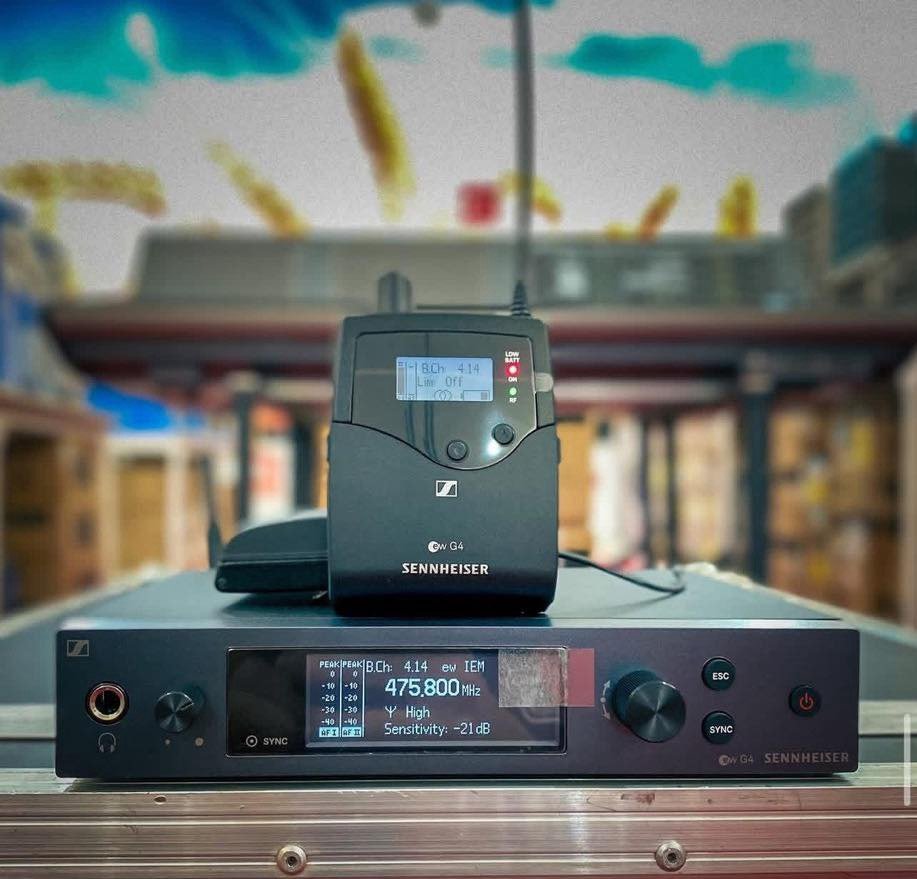
Sennheiser EW IEM G4 Twin is a wireless in-ear monitoring system for delivering a monitor feed to performers wearing bodypack receivers. This stock is identified as the A1 version, covering 470–516 MHz. The system belongs to Sennheiser’s evolution wireless G4 monitoring range and uses an SR IEM G4 stereo transmitter with EK IEM G4 bodypack receivers. It is offered in Excellent condition, with 22 inventory units available at €800 per listed unit.
The Twin monitoring configuration
Sennheiser documents its standard Twin configuration with one SR IEM G4 transmitter and two EK IEM G4 receivers. The transmitter carries the monitor programme, and the receivers provide the listening connection for the performers. Both receivers can listen to the programme transmitted by the same SR IEM G4 unit, with listening adjustments available at each bodypack.
This describes the manufacturer’s Twin architecture. The exact supplied components and accessories for the offered used stock should be checked against the seller’s itemised contents. A manufacturer’s new-set delivery list does not establish that earphones, batteries, mounting parts or other accessories accompany each used inventory unit.
Audio connections at the transmitter
The SR IEM G4 is a half-rack stereo transmitter with a metal enclosure and an OLED display. Its two electronically balanced audio inputs use combination XLR and 6.3 mm jack sockets. They take the left and right sides of the monitor feed from the mixing system. The transmitter also provides balanced loop outputs and a local headphone-monitoring connection.
For a monitor position, identify the console outputs feeding those two inputs and the intended listening mode before setting levels. The audio connection at the transmitter and the listening settings at the bodypack perform different jobs. Keeping the signal routing clear makes it easier to check whether a problem originates in the mix feed, the wireless link or the receiver’s listening configuration.
Stereo and Focus listening with Sennheiser EW IEM G4 Twin
The EK IEM G4 offers Stereo and Focus modes. In Stereo mode, the left and right signals retain their stereo presentation, and Balance adjusts the relationship between the two sides. Sennheiser specifies that the corresponding transmitter should also operate in Stereo mode for this arrangement.
Focus mode provides a different use for the same two transmitted audio channels. When the transmitter operates in Stereo mode, the receiver combines its left and right inputs into a mono listening signal available in both headphone channels. The performer’s Balance setting then changes the relative contribution of those two input channels. This can support a monitor arrangement built around two deliberately prepared source feeds. If the transmitter operates in Mono mode, the receiver receives the transmitter’s left audio input as the mono programme. These choices are explained in the official EK IEM G4 mode guide.
Understanding the A1 frequency range
The A1 designation identifies the hardware’s 470–516 MHz tuning range. A selected frequency is one operating point within that range. A frequency shown on a display is therefore different information from the complete band designation on the equipment label.
When putting a system together, Sennheiser instructs users to match transmitters and receivers from the same frequency range and set both ends of the intended link to the same frequency. The manufacturer publishes an A1 frequency sheet for ew IEM G4. Use that range-specific information when planning channels. A hardware tuning range does not establish which channels are suitable at a particular venue or how many radio links can operate there at once.
Scanning and coordinating channels
The receiver’s Easy Setup menu scans for unused frequency presets. Sennheiser’s procedure calls for transmitters to be switched off during the scan so their signals do not occupy the channels being assessed. Scan New List searches the receiver’s range, after which the operator selects a frequency bank and an available channel from the results. Current List recalls the previous scan list, while Reset List clears it.
The squelch threshold influences the scan results, so channel selection and squelch should be considered together. For a larger monitoring setup, the documented workflow can distribute scan results to networked SR IEM G4 transmitters in the same frequency range. This is a coordination facility, not a guarantee of interference-free operation. The manufacturer’s Easy Setup instructions explain the scan and multi-channel sequence.
Infrared synchronisation
Sennheiser EW IEM G4 Twin uses infrared interfaces for synchronising compatible IEM G4 components. Easy Setup Sync can transfer unused presets found by the receiver to a transmitter. In the other direction, the transmitter’s Sync function sends selected receiver parameters to an EK IEM G4 bodypack.
The direction of the transfer matters: scanning with a receiver and passing its frequency information to a transmitter is a different operation from configuring a receiver from the transmitter. The display confirms a completed transfer. Follow the official synchronisation procedure and verify the resulting settings on the intended components before relying on the monitor feed.
Receiver controls and listening adjustments
The EK IEM G4 menu groups the settings needed at the performer’s receiver. These include frequency bank and channel, an editable name, Balance, Stereo or Focus mode, High Boost and automatic lock-off. The Advanced menu provides further controls, including Tune, Limiter, Volume Boost and display contrast.
These controls let the operator distinguish RF setup from the listener’s preferred presentation. For example, the frequency setting determines the radio programme being received, while Balance and Mode determine how its audio channels are presented. Review the receiver’s existing settings when preparing a used unit for a different performer or show.
Power and receiver operation
The EK IEM G4 receiver design accepts two AA batteries or the specified Sennheiser BA 2015 rechargeable pack. Sennheiser lists an approximate operating time of four to six hours, depending on volume level. That is a manufacturer operating figure, rather than a measured runtime for this used stock.
The receiver’s technical documentation describes adaptive diversity, the HDX compander, adjustable squelch, High Boost and an adjustable limiter. Power arrangements and listening settings should be planned together for the intended show.
Networked control and engineering workflows
An SR IEM G4 transmitter can be monitored and controlled through Sennheiser Wireless Systems Manager over its Ethernet connection. The manufacturer describes connecting the rear RJ45 socket to a network switch. Automatic frequency setup can also be carried out over the network without using WSM, following the documented Easy Setup procedure. The network is a setup and control connection; the performer’s audio reception still depends on the correctly configured wireless monitor link.
The EK IEM G4 also provides Engineer Mode. This can store up to 16 receiver-setting profiles and load a selected profile so an engineer can monitor the corresponding programme. Saved profiles include settings such as frequency, name, Balance, Mode and limiter. These profiles provide quick access to known receiver configurations during a monitor-engineering workflow.
Condition, quantity and unit price
Sennheiser EW IEM G4 Twin is offered in Excellent condition. Available stock is 22 listed inventory units, and the price is €800 per unit. The stock count is availability at the stated individual price.
Official references and related monitoring equipment
Consult the official Sennheiser EW IEM G4 Twin A1 product information, the Twin system specification and the ew IEM G4 operating documentation for model-specific information. Browse In-Ear Monitoring at Bsound Pro Audio for related monitoring equipment.
There are no reviews yet. Be the first one to write one.